
Alphabet Inc., the parent company of Google, has launched a fresh challenge against Elon Musk’s Starlink with the introduction of Taara Lightbridge, a new standalone company using laser technology to deliver high-speed internet. Originally developed under Alphabet’s X “moonshot” division, Taara employs Free Space Optical Communication (FSOC) technology to transmit internet signals through beams of light over long distances, presenting an alternative to satellite broadband.
The announcement, made on Monday, March 17, marks Alphabet’s renewed commitment to expanding global connectivity following the shutdown of its Project Loon balloon initiative in 2021. Led by CEO Mahesh Krishnaswamy, Taara aims to connect three billion people worldwide, including 860 million across Africa who lack access to reliable internet. The company will directly compete with Starlink, which has already gained over five million subscribers in 125 countries.
Though still in its testing phase, Taara is operational in 12 countries and is now focusing on scaling its services across Tanzania, Kenya, Zimbabwe, and Nigeria. With demand for affordable, high-speed internet rising, tech firms are exploring alternatives to traditional fiber-optic networks, which remain underdeveloped in many regions due to high installation costs and difficult terrain.
Taara’s FSOC technology functions like an invisible fiber-optic cable in the sky, transmitting data via laser beams instead of through physical cables. This method allows for speeds of up to 20 gigabits per second over distances of 20 kilometers. However, because light-based communication requires a clear line of sight, disruptions can occur due to obstacles like fog, rain, or buildings. To address this, Taara has developed AI-driven mirror systems capable of detecting and maintaining precise alignment between connected units to ensure a stable connection.
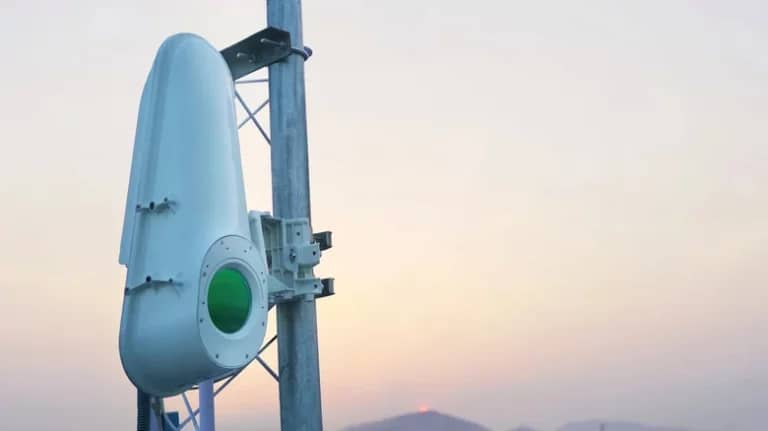
Speaking on Google’s Moonshot Podcast on Monday, Krishnaswamy explained that Taara uses a traffic light-sized box to house the laser, which can be mounted on rooftops or cell towers. Early deployments have demonstrated the technology’s effectiveness, with successful trials in India, where Taara connected urban buildings via cell towers. In Africa, the system was used to bridge the Congo River, linking Kinshasa and Brazzaville, where under-river fiber installation was impractical.
To expand its reach, Taara plans to partner with internet service providers, telecom firms, and governments to extend connectivity to rural villages, disaster-hit areas, and underserved regions. Among its key collaborators is Liquid Telecoms, a subsidiary of Cassava Technologies, a pan-African technology group.
While fiber-optic cables remain the backbone of internet infrastructure, their high costs and complex deployment make them less feasible in remote locations. Compared to Starlink’s satellite-based model, Taara’s ground-based FSOC approach offers a potentially more cost-effective solution, requiring less energy and eliminating space-related expenses.
Krishnaswamy also revealed that Taara is working on miniaturizing its FSOC terminal, reducing its size from a traffic light to a fingernail, significantly lowering deployment costs. He noted that this innovation could allow households to install smaller, more affordable devices without the need for fiber trenching.
“You could have these small devices on every home with no bottlenecks, at a fraction of the cost of traditional infrastructure,” he said.