
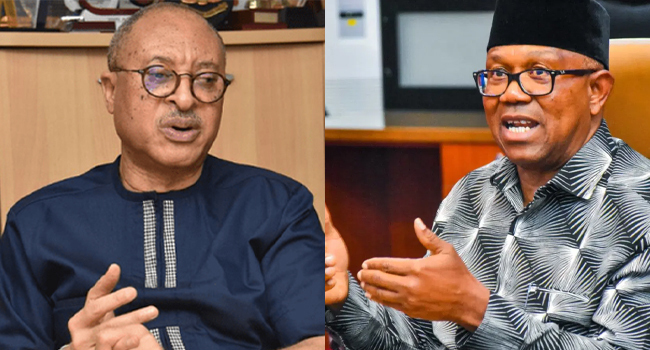
Political economist Pat Utomi says the presidential campaign of Peter Obi under the Nigeria Democratic Congress (NDC) plans to strengthen the naira to N500 per dollar and reduce the prices of essential goods if elected in 2027.
Utomi disclosed the proposed targets in a post on X, describing them as part of the party’s economic blueprint to tackle inflation, reduce poverty and improve Nigerians’ purchasing power.
He said the plan would involve investments in security, electricity and road infrastructure, alongside structural reforms intended to improve the competitiveness of the Nigerian economy.
Under the proposal, a loaf of sliced bread currently selling for about N1,750 could drop to N800, while a 50kg bag of imported rice priced at N55,000 could fall to N27,500.
Utomi also projected that a medium-sized yam could decline from N2,400 to N1,200, while a 50kg bag of maize could drop from N75,000 to N37,500. Plantain, currently priced at about N2,500, could sell for N1,250, while the price of a whole chicken could fall from N7,000 to N3,500.
He added that a dozen eggs could cost N1,150 instead of N2,300, while a painter of garri could drop from N1,300 to N650. He also predicted lower prices for petrol and cement without providing specific figures for the two products.
“We are convinced that targeting a strategic appreciation of the exchange rate by reasonably strengthening it from ₦1,350/$ to ₦500/$ as part of our manifesto is a winning strategy,” Utomi said.
“It offers a direct, multi-faceted approach to curbing inflation, reducing poverty, and lowering the cost of living.”
Utomi described the proposal as a plan to improve the living conditions of what he estimated to be 140 million Nigerians experiencing multidimensional poverty.
However, he did not specify when the proposed N500-to-dollar exchange rate would be achieved or outline the monetary and fiscal measures required to sustain such an appreciation.
The projected exchange rate and commodity prices remain campaign targets rather than guaranteed outcomes, as their feasibility would depend on the economic policies implemented and prevailing market conditions.