

By: Adegoke Aishat, Adeniyi Oluwatomisin,Adeniji Oluwadamilare, Adewara Ifeoluwa, Adeboyejo Oluwagbolabo
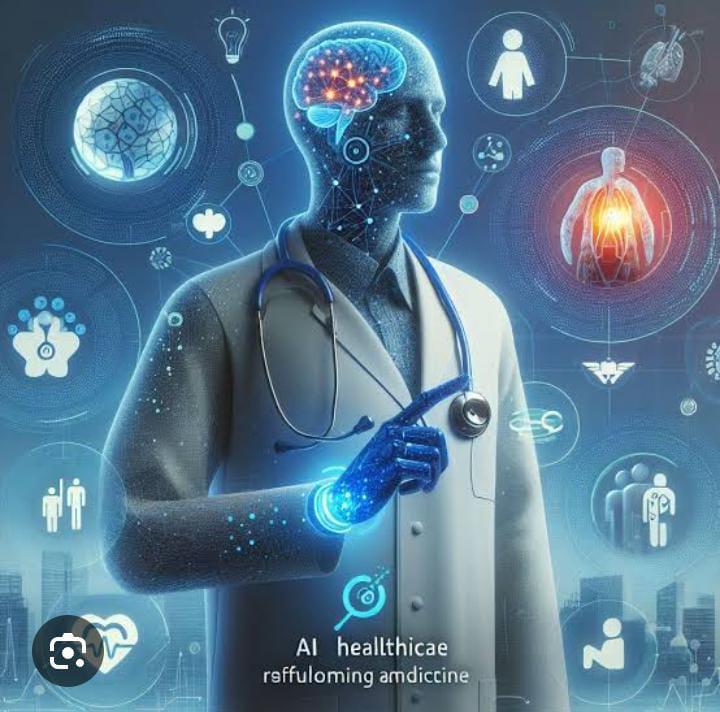
In recent years, artificial intelligence has emerged as a transformative force in the healthcare sector, reshaping the delivery of medical services across the globe.
By leveraging advanced computational techniques, artificial intelligence systems are capable of analysing vast amounts of clinical data, supporting diagnostic accuracy, enhancing treatment personalization, and streamlining administrative processes.
From predictive analytics to robotic surgery and virtual health assistants, the applications of artificial intelligence are rapidly expanding.
AI-powered algorithms can analyse vast amounts of medical data, including images and patient histories, to detect diseases earlier and more accurately than ever before.
Imagine walking into a doctor’s office and being diagnosed with precision and care, AI can help tailor treatment plans to individual patients based on their unique genetic profiles, medical histories, and lifestyle factors.
This approach can lead to more effective treatments and better patient outcomes, AI can also automate administrative tasks like scheduling appointments or answering medical questions.
This frees up doctors time to focus on more complex cases, AI also analyses patient data to predict health risks and this helps doctors provide personalized care and prevent illnesses, freeing up healthcare professionals’ time to focus on what matters most which is patient care. By streamlining clinical workflows, AI has helped reduce wait times, improve patient satisfaction, and increase productivity.
The future of AI in healthcare is full of possibilities and potential to reshape how care is delivered, accesses and experienced.
In the prescribing of precision medicine, Ai is set to revolutionise healthcare that is tailored towards that individual rather than just the disease. This process involves analysing genetic, lifestyle and environmental data to determine what treatment can work best for each person.
More so, Ai-powered diagnostic tools are becoming sharper, faster and more accurate, The future implications is that it can help to detect diseases like cancer, heart disease, etc from simple scans, blood tests or even voice patterns.
We can also see image recognition software
that reads radiology images more accurately than the human eye which can reduce human error and speed up diagnosis.
Furthermore, Ai can streamline clinical workflows by automating administrative tasks like billing, documentation and appointment scheduling for patients. This means doctors spend less time on paperwork and more time connecting with patients. Therefore, humanising healthcare in an age of technology.
However, Data Privacy and Security Artificial intelligence applications in healthcare are heavily reliant on the collection and analysis of large-scale patient data, including electronic health records, imaging, genomic information, and real-time biometric data.
This dependency introduces significant vulnerabilities concerning data privacy and cybersecurity. The potential for data breaches or unauthorized access to sensitive health information poses risks not only to individual patients but also to public trust in artificial intelligence technologies.
To mitigate these concerns, rigorous data protection protocols, transparent data governance structures, and strict compliance with legal frameworks such as the Health Insurance Portability and Accountability Act (HIPAA) and the General Data Protection Regulation (GDPR) are essential.
The pace of innovation in artificial intelligence has outstripped the development of comprehensive regulatory and ethical guidelines. Currently, many jurisdictions lack robust frameworks to assess the safety, efficacy, and accountability of artificial intelligence-driven medical tools.
Ambiguities persist regarding liability in cases of error or harm, as well as the standards by which artificial intelligence systems should be validated prior to clinical deployment.
It is crucial for regulators, technologists, ethicists, and healthcare providers to collaborate in designing adaptive, evidence-based frameworks that balance innovation with patient safety, informed consent, and professional responsibility.
While artificial intelligence is not expected to replace clinicians outright, it may alter the nature of healthcare roles, particularly in areas such as diagnostics, medical imaging, and health information management.
This shift necessitates the redefinition of professional responsibilities and the reskilling of healthcare workers to effectively engage with artificial intelligence systems.
Long-term success will depend on integrating artificial intelligence as a collaborative tool that augments, rather than replaces, human expertise in clinical settings.
As artificial intelligence continues to evolve, its role in modern medicine is rapidly shifting from experimental to essential. Already powering critical tools in diagnostics, predictive analytics, and personalized care, AI is laying the foundation for a smarter, more responsive healthcare system.
The integration of quantum computing promises to amplify this revolution, offering unprecedented processing capabilities that could unlock breakthroughs in genomics, drug discovery, and real-time disease modelling.
Yet, amid these exciting advancements, caution must not be cast aside.
Ethical concerns, data protection, algorithmic bias, and the need for robust regulation remain pressing issues. Experts stress that without clear guidelines and human oversight, the risks could undermine public trust in these powerful technologies.